
Remember that sustainability questionnaire from Part 1? Somewhere on page two, it asked you to report your “Scope 1, 2, and 3 emissions.” You Googled it, got a wall of jargon, and closed the tab.
Here’s scope 1, 2, and 3 emissions explained without the jargon.
Scope 1: What You Burn
Scope 1 covers everything your business emits directly. If your company owns it and it produces greenhouse gases, it counts.
The gas in your factory boiler. The diesel in your delivery vans. The fuel oil heating your warehouse. If you can walk up to it and it’s burning something, that’s Scope 1.
For a manufacturer, think furnace and fleet. For an office-based company, it might just be the company cars and a gas boiler. These are the emissions you control.
Scope 2: What You Plug In
Scope 2 is the energy you buy. You didn’t burn anything — the power plant did — but you bought what it produced.
Your electricity bill. The heating system your building uses. Every time you flip a switch, that energy was generated somewhere. The emissions from generating it are yours to report.
Here’s what makes Scope 2 interesting: switch your electricity contract to a renewable energy provider, and your Scope 2 can drop to zero. No other scope is that responsive to a single decision.
The distinction: Scope 1 is fuel you burn on-site. Scope 2 is fuel someone else burned to give you electricity, heat, or steam.
Scope 3: What Others Do for You — or Because of You
Scope 3 is everything else. And it’s enormous.
Before your product reaches you: the steel mill that made your raw materials, the factory that built your components, the truck that delivered them. After your product leaves: the customer using it, the energy it consumes, the landfill it ends up in.
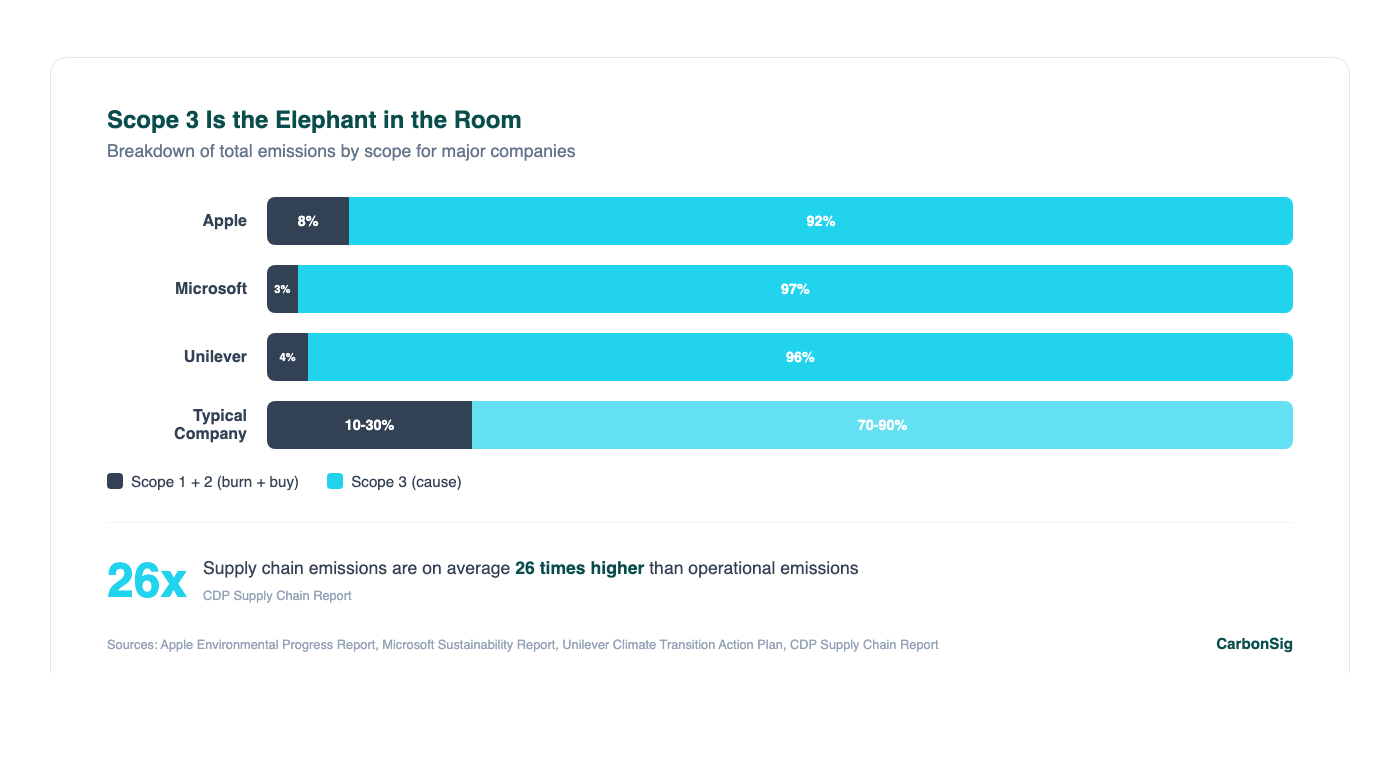
The GHG Protocol (the international standard behind carbon reporting) defines 15 categories of Scope 3 emissions. You don’t need to memorize them. You need to know one thing: for most companies, Scope 3 is 70 to 90 percent of their total carbon footprint.
Apple’s Scope 3 is 92% of its total. Microsoft’s is 97%. And it is not just tech companies: Unilever’s Scope 3 is 96% — for a food and consumer goods company, the supply chain dominates just the same. Not because these companies are careless — because the vast majority of emissions happen in supply chains, not office buildings. In fact, CDP research shows that supply chain emissions are on average 26 times higher than operational emissions.
Scope 1, 2, 3 Emissions: The Chain That Connects Everyone
Here’s the part that changes how you see this.
Your Scope 1 — your furnace, your fleet — shows up as Scope 3 on your customer’s report. When they measure scope 3 emissions from their supply chain, they’re measuring you.
It works the other way too. Your supplier’s Scope 1 is part of your Scope 3.
“Every business is part of someone else’s Scope 3.”
Scopes aren’t three separate boxes. They’re a chain. Every business is part of someone else’s Scope 3. When regulations require large companies to report all three scopes — and they increasingly do — the data request travels down the supply chain. To you.
That questionnaire on your desk? Now you know what it’s asking and why.