
You run a 50-person company, not an oil refinery. So what is carbon accounting, and why are they asking you for it?
Carbon accounting in plain English
Carbon accounting is how a business measures the greenhouse gases it produces. Think of it like financial accounting, but instead of tracking dollars, you track emissions — the diesel in your delivery van, the gas heating your warehouse, the electricity running your production line.
The unit of measurement is CO2 equivalent, a single number that represents your total carbon footprint.
In practice, it means a company adds up its climate impact the same way it adds up its expenses. Methodically. In a format other people can verify.
Why businesses measure carbon now
Three forces pushed carbon from boardroom buzzword to business reality.
Regulations landed
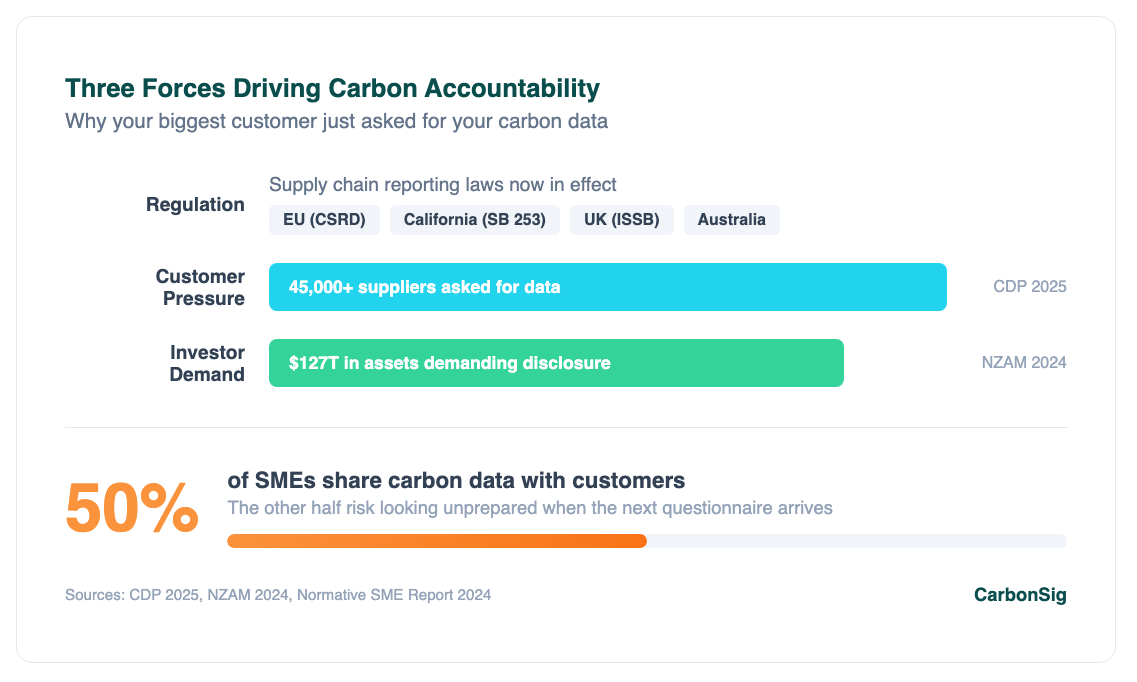
The EU now requires large companies to report emissions across their entire supply chain — including yours. California, the UK, and Australia are rolling out similar rules.
Customers started asking
In 2025, 270 major corporate buyers requested carbon data from over 45,000 of their suppliers through CDP, a global disclosure platform. Your customer’s questionnaire is not a one-off. It is a trend.
Investors followed the money
Asset managers controlling $127 trillion in investments now demand carbon disclosure from the companies they fund (Net Zero Asset Managers Initiative, 2024). That pressure flows downhill — from public companies to their suppliers to you.
From nice-to-have to business requirement
Your company may not be regulated directly. But your customers are. When they report their emissions, they have to include the emissions from their supply chain. That means they are measuring you whether you participate or not.
“They are measuring you whether you participate or not.”
This is the same pattern quality management followed 30 years ago. ISO 9001 started as optional. Then big buyers made it mandatory for suppliers.
Today, 98% of multinational companies embed environmental criteria in their procurement decisions (UN Global Compact, 2024). Apple has already suspended supplier contracts over environmental non-compliance. Carbon data is heading the same direction.
Right now, roughly half of small and mid-sized businesses share carbon data with their customers (Normative SME Carbon Report, 2024). The other half risk looking unprepared when the next questionnaire arrives.
What this means for you
That email is not a box-ticking exercise. It is a signal that your market is shifting.
You do not need to become a climate scientist. You need to understand what is being asked, why, and how to respond. Start there.
The companies that figure this out early will not just keep their contracts. They will win new ones.
Next in this series: Scope 1, 2, 3: What You Burn, What You Buy, What You Cause — the three categories every supplier questionnaire asks about.